Safety Workshops
in Schools
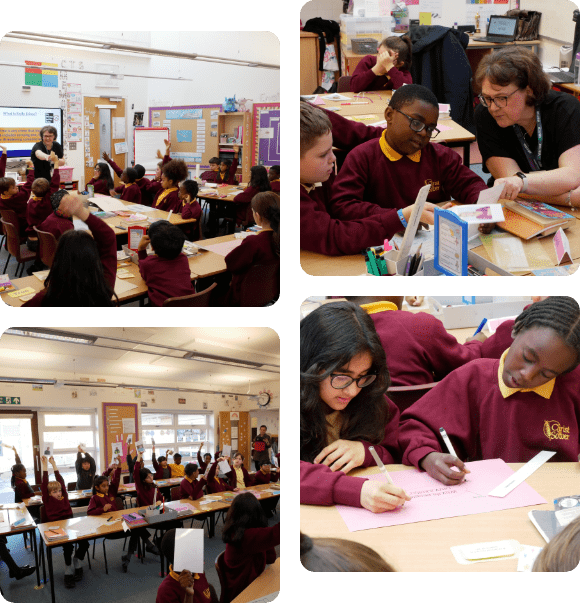
We deliver classroom based workshops in schools on a variety of safety related themes.
By actively engaging and teaching children and
young people about how to lead a safe life, our aim
is to instil lasting messaging that will stay with them
forever and have the potential to save lives.
Workshops for children
Empower and Challenge – Tacking Violence Against Women & Girls
Suitable for years 6-8
Our Violence Against Women and Girls Programme provides opportunities for vital conversations that will empower and equip young people with the knowledge and understanding around Violence Against Women and Girls.
This session lasts for 1 hour.
The workshops highlight the importance of equity and respect and offer an opportunity for both female and male students to consider the key features of healthy and unhealthy relationships, recognising harmful gender stereotypes, attitudes and behaviours, the impact verbal and non-verbal violence has and the laws around it.
Students will gain an understanding of the type of language and behaviour that is appropriate, both on and offline, as well as gaining a good understanding of what is meant by consent, the importance of gaining, as well as giving consent and that consent can be withdrawn at any time. The workshop will highlight the importance of calling out inappropriate behaviour in perpetrators to protect victims.
All students should feel empowered to identify the early warning signs and understand the importance of speaking out to get help for themselves, or others. The sessions signpost where young people can seek this support.
Knife Crime Intervention
Suitable for years 5-7
Through a variety of age-appropriate practical activities and meaningful discussions, the children work through a scenario-based activity, identifying the choices being made and the consequences of these choices. As the scenario escalates, the children learn about the risks of carrying knives and the laws around knife crime.
This session lasts for approx 75 minutes.
The session includes:
- Discussions around why people carry knives.
- Understanding the importance of making the right choices and the choices made will have consequences that can impact themselves and other people.
- Addressing misconceptions around knife related crime.
- Impact of peer pressure when making choices.
- The laws around knife related crime, including carrying, using and being a bystander.
- Where to go for support if young people are worried about themselves or other people.
Online Safety
Suitable for years R-6
This is one of our most popular sessions.
Our sessions help children identify and navigate the risks of the online world. Through a variety of age-appropriate practical activities and videos, the children are taught how to recognise risks, who they can talk to and where they can report content that upsets or worries them.
This session lasts for approx 75 minutes and each session builds on the content from the previous year.
The sessions include:
All year groups contain the following content, at an age-appropriate level:
- Discussions about suitable app and game age restrictions.
- The risks of sharing too much personal information and the different ways it can be shared.
- Thinking about who they might be talking to online – are people always who they say they are?
- Importance of privacy settings, usernames and passwords.
- Who they can go to for support if they are worried.
Year 4, 5 and 6 also contain some of the following:
- The risks of photo sharing and live streaming
- The risks and laws around sexting – Year 6
- Identifying what Cyberbullying is and what to do if it happens – Year 5 and 6
Drug & Alcohol Safety
Suitable for years 5 & 6
This age-appropriate session highlights the distinction between illegal drugs, medicines and socially acceptable drugs including tobacco, alcohol, and caffeine.
The children are involved in paired and small group activities including the opportunity to discuss and role play situations involving peer pressure and how to deal with it. ‘County Lines’ is also discussed within the session.
This session lasts for approx 75 minutes.
The session includes:
- What are drugs and why do people take them?
- Types of Drugs – Legal (socially acceptable and prescription) and illegal
- The effect of caffeine, alcohol and smoking can have on our bodies and the law relating to them
- How illegal drugs can affect the people who take them, and the laws around taking drugs
- The dangers of volatile substances such as aerosols
- What addiction is and how it happens
- Saying ‘No’ to drugs – Peer pressure role play (including a scenario based on County Lines)
Emergency Services Lesson
Suitable for year 2
In this session we teach the children about how to recognise the different emergency services by the uniforms they wear, the service they provide and the vehicles they drive.
Pupils all have the opportunity to dress in real emergency service uniforms and all learn how to make a 999 call using our special telephone system.
This session includes:
- What is an emergency?
- Who are the emergency services?
- What do they wear?
- What do they drive?
- What do they do?
- Contacting the emergency services – which number to ring, which emergency service do the need, which information you may need to give the call handler from the emergency services.
All students should feel empowered to identify the early warning signs and understand the importance of speaking out to get help for themselves, or others. The sessions signpost where young people can seek this support.
Gas and Carbon Monoxide Safety
Suitable for years 4-6
In this session we cover ‘What is Natural Gas and where does it come from?’
We also explore dangers and symptoms of Carbon Monoxide, including an interactive drama explaining the effects of carbon monoxide poisoning and identify what we should do in a Gas Emergency – Natural Gas/Carbon Monoxide.
This session lasts for approx 75 minutes.
The session includes:
- What natural gas is and where it comes from, how it gets to our homes and how it is used.
- Properties of natural gas and why it is dangerous.
- What to do in a gas or carbon monoxide emergency.
- Who are Gas Safe Engineers?
- What is Carbon Monoxide and how is it made?
- What happens if we breathe in carbon monoxide?
- Who can we contact in an emergency?
First Aid
Suitable for years 5 & 6
This workshop equips young people with the knowledge and skills to save a life. It focusses on basic life support and bleeding.
This session lasts for approx 75 minutes.
The sessions include:
- Basic life support: approaching the scene, assessing a casualty, placing the casualty in the recovery position.
- Bleeding: types of bleeds, how to assess and respond to a bleed, use of bandages to take care of a person with a bleed. How to treat a casualty that is going into shock.
During the session children will also be taught how to communicate with an operator in an emergency call. They will also receive a certificate from The Safety Centre.
Requirements: Hall space, mats – 1 between 2
Number of children: 15 minimum per group.
*Please contact us if you would like a first aid session that covers the programme of study for a different year group.
Road Safety
Suitable for years R-6
Our Road Safety workshop equips children with the knowledge and skills to be safe around roads as a pedestrian, cyclist, or passenger in the car. If looks at who uses the roads and who is responsible for safety. All workshops are age-appropriate and interactive and cover the following vital learning.
This session lasts for approx 75 minutes and are delivered in a classroom.
The session includes:
- Discussion around how children travel to school.
- The Green Cross Code.
- Identifying safe places to cross the road.
- The importance of being seen at night.
- How to be safe on bikes and as a passenger in vehicles.
- Thinking about stopping distances of vehicles (Year 3 – 6).
- Identifying blind spots and why they are dangerous when crossing roads (Year 4 – 6)
- Practical crossing activities using traffic lights and Zebra Crossing in the classroom or playground (Reception and Year 1)
Staying Safe On The Roads
Suitable for KS3
This workshop equips young people with the knowledge and skills to stay safe as pedestrians, car passengers and drivers.
This session lasts for 1 hour.
This session includes:
- The responsibilities of being a pedestrian, passenger or driver
- Identifying unsafe behaviours that could lead to accidents
- The impact of taking risks and how to manage risks.
During the session children will also be taught how to communicate with an operator in an emergency call.
Number of children: Maximum 30
BEING A RESPONSIBLE DRIVER
Suitable for KS4 & KS5
This 2 part workshop focuses on being a responsible driver and the importance of having motor insurance. This workshop supports PSHE units on travel safety, financial independence and critical awareness of advertising.
This session consists of 2 sessions, each taking 1 hour.
The session includes:
- The personal responsibilities young people have when travelling and how to manage the risks involved.
Number of children: Maximum 30
Workshops for adults
Parent Online Safety Session
Max group size: 50
Face to face and online sessions available
This session is aimed at Parents and Carers and identifies the positive aspects of using technology, as well as addressing the current risks that children can face online. It looks at age-appropriate apps and games, as well as the risks associated with adults and children sharing too much information and being aware who children might be talking to online.
The sessions can be offered during the school day, after school or during the evening, they are strictly for parents only as the content is not suitable for children. There are a wide range of resources available for parents and carers to access after the session
The session lasts for approximately 75 minutes and can be delivered face to face in school, virtually via Zoom or as a remote link to a video.
This session includes:
- Introduction – Up to date, key research findings and statistics concerning online safety for children.
- Risks faced by children – Sharenting, oversharing, photo/live streaming, grooming, social media, gaming, cyberbullying, sexting, challenges and dares.
- What parents can do – Including setting parental controls, monitoring apps, conversations, and family agreements.
- Where to go for help
Staff Online Safety Sessions
Max group size: 50
Face to face and online sessions available
This session is aimed at school staff and identifies the current risks for children online. It informs staff about responding to incidents in school, identifying the key online reporting tools as well as the importance of managing their professional reputation online. School day or twilight sessions are offered as a staff meeting or INSET session.
This session lasts for approx 75 minutes.
The session includes:
- Introduction – Up to date, key research findings and statistics concerning internet safety for children
- Risks faced by children – Sharenting, oversharing, photo/live streaming, grooming, social media, gaming, cyberbullying, sexting, hate crime and radicalisation.
- Professional reputation – Protecting yourself
- Staff Support/School Guidance – Key documents for schools
- Curriculum Support – Resources available
- Where to go for help
Feedback from schools that have
benefitted from our educational input